A useful outdoor exercise area is more than a row of machines: it gives different people a safe route through cardio, strength, mobility, balance and recovery activities. By the end, you will be able to plan the site, select complementary equipment, specify access and fall protection, and judge whether the finished space supports regular use.
Key takeaways
- Arrange cardio, strength, and mobility stations into a repeatable circuit.
- Map entrances, circulation, visibility, clearances, and emergency access before installation.
- Test drainage, heat, slope, and surface durability before choosing flooring.
- Match equipment to user abilities, then inspect, maintain, and measure the area.
Build a movement sequence instead of a row of machines
A functional exercise area links movement opportunities into a simple circuit, rather than displaying unrelated machines in a row. Organise the site into a cardio zone, strength zone, and mobility and recovery zone so users can choose an entry point, repeat a circuit, or skip movements that do not suit their ability.
- Start with low-barrier movement: walking space, a recumbent cycle, or a cross-trainer for aerobic work.
- Add strength stations covering pushing, pulling, squatting and stepping, with at least one usable option for seated or standing users.
- Include trunk, balance and coordination activities, such as supported balance rails or low step platforms, without making every user pass through them.
- Finish with stretching, gentle mobility and seating in the mobility and recovery zone, where users can pause without blocking the circuit.
Treat each equipment type as a function, not merely a product count. Older adults may need back support and handrails, beginners need obvious controls and manageable resistance, teenagers need challenge, and wheelchair users need a clear approach, adjacent floor space and a practical transfer position.
A route that reaches a station but leaves its controls or transfer side blocked is not inclusive.
Test the sequence with real users before finalising it. Observe whether people can understand the next station, complete a circuit, rest safely and leave without crossing another user’s movement path. That is what makes the area functional.
Map access, circulation and safety before choosing equipment
A safe outdoor fitness layout begins with a continuous accessible route, not with the machines. Use a firm, stable, slip-resistant surface with a running slope no steeper than 1:12 and a cross slope no steeper than 1:48; a route ending at loose aggregate, a step or a drainage lip is not practically accessible.
Draw the plan at scale before selecting equipment. Mark the entry, route, turning areas, seating, drinking water, shade, lighting and sightlines, then place stations so one user does not block another’s path.
- Keep an unobstructed route between stations and provide a clear floor area beside each machine for a wheelchair approach, controls and transfer where the design requires it.
- Use the manufacturer’s installation drawing for equipment spacing and fall zone measurements. Do not estimate a clearance from the equipment’s footprint.
- Separate moving equipment from walking paths, benches and children’s play areas; a swinging arm or rotating handle must not enter a circulation route.
- Face labels and controls toward the approach side. A user who cannot reach the instructions or operating parts cannot use the station independently.
| Area element | Plan for | Failure to prevent |
|---|---|---|
| Accessible route | Continuous surface, 1:12 maximum running slope and 1:48 maximum cross slope | A wheelchair reaches the area but cannot reach a station |
| Station clearance | Approach, operating and transfer space under ADA Sections 236 and 309 | Obstructed controls or no usable transfer position |
| Fall protection | Manufacturer’s fall zone measurements and required surface | A moving user lands in a path, on a hard edge or beside another station |
Specify EN 16630:2015 or ASTM F3101 where applicable, alongside local accessibility and surfacing rules. Playground standard ASTM F1292 alone does not define outdoor-fitness equipment safety.
Test the site and choose a surface that will remain usable
Ground conditions and drainage determine whether an outdoor exercise area stays usable after installation. Water that ponds beneath equipment, frost-heaved edges and shifting aggregate create trip hazards and block wheelchair access. Inspect the site after rain, probe soft areas and trace runoff before setting equipment locations.
Keep the route and each equipment pad firm, stable and slip-resistant. Limit the running slope to 1:12 and cross slope to 1:48 where ADA access applies; a compliant path still fails in practice if it ends at a drainage lip or loose stone. Provide level clear space beside each station for approach and transfer.
Choose outdoor gym surfacing by exposure, maintenance capacity and fall risk:
| Surface | Strength | Watch for |
|---|---|---|
| Poured-in-place rubber | Seamless, with few joints for wheelchairs and high traffic | Requires a correctly prepared, draining base |
| Rubber tiles | Individual sections can be replaced after damage | Lifted edges and open joints become trip hazards |
| Compacted soil drainage | Low-cost base approach for suitable, low-risk areas | Erosion, rutting and poor wet-weather access |
Do not rely on compacted soil drainage alone where water collects. Grade the subbase, install suitable drainage and inspect after heavy rain. Specify EN 16630:2015 for permanently installed adult outdoor fitness equipment, and identify the applicable local surfacing rule; ASTM F1292 addresses playground impact attenuation, not every exercise surface.
Match equipment types to users, then turn them into a circuit
Match equipment to movement ability, not to a generic “all users” label. Fixed outdoor machines suit beginners and older adults who need guided motion; calisthenics bars suit teenagers and experienced exercisers who can control their body weight; bodyweight stations work across levels when height, grip and transfer access are specified.
| Option | Best-fit users | Practical progression |
|---|---|---|
| Fixed outdoor machines | Beginners, older adults, users wanting guided resistance | Learn the motion, complete short sets, then add repetitions |
| Calisthenics bars | Teenagers and experienced exercisers | Hang, support, pull, then progress to controlled pull-ups |
| Bodyweight stations | Users needing simple strength or mobility exercises | Use supported squats and push-ups, then reduce support |
| Walking paths | Beginners, older adults and users building endurance | Walk steadily, increase duration, then add brisk intervals |
Build the circuit from low risk to higher skill. Keep each station beside a firm route and an equipment pad; an accessible route needs a running slope no steeper than 1:12 and a cross slope no steeper than 1:48.
Provide clear approach and operating space, then check the manufacturer’s installation drawing instead of guessing fall zones.
- Start with five minutes on walking paths.
- Use one fixed machine for eight to twelve controlled repetitions.
- Add a supported bodyweight exercise and a balance movement.
- Rest at seating or shade, then repeat once.
- Offer calisthenics bars as the progressive option, not the entry point.
When specifying a station, Fabrotech Engineers can be asked to state its intended user range, approximate resistance or counterweight, adjustment limits and required clearances instead of calling every unit suitable for all abilities.
Related products
 | OUTDOOR GYM MANUFACTURER Multi Gym Set – Complete Outdoor Fitness Solution The Multi Gym Set by Fabrotech Engineers is a versatile outdoor fitness system designed to support full-body workouts in parks, playgrounds, and open... View product → |
 | OUTDOOR GYM MANUFACTURER Trade Mill – Outdoor Fitness & Cardio Equipment The Trade Mill by Fabrotech Engineers is a robust outdoor fitness equipment designed to promote cardiovascular health and physical endurance. View product → |
Specify, operate and measure the area after installation
Opening day is the start of operation, not proof of success. Specify equipment against ASTM F3101 and EN 16630:2015, then confirm local building, accessibility, electrical and surfacing rules separately. EN 16630:2015 covers permanently installed outdoor fitness equipment for adults; ASTM F3101 addresses unbound exercise equipment. Neither replaces local requirements.
Include these operating controls in the handover brief:
- Provide the manufacturer’s inspection schedule, cleaning method, lubrication points, spare-part list, reporting contact and equipment maintenance log.
- Label each station with its purpose, starting position, movement instructions, user limits and a simple difficulty cue.
- Keep the accessible route firm, stable and slip-resistant, with a running slope no steeper than 1:12 and cross slope no steeper than 1:48. Provide compliant approach, operating and transfer space under 2010 ADA Sections 236 and 309.
- Record repair response times, temporary closures and the person responsible for reopening each station after inspection.
- Run a post-occupancy evaluation at set intervals, recording users by time of day, visit duration, station turnover, completed circuits, use by people with mobility limitations, downtime, complaints and near-miss reports.
Use those findings to adjust signs, lighting, seating, programming or equipment placement. A station that remains empty, blocked or confusing is a failed service even when every unit passed installation inspection.
Frequently asked questions
How should outdoor fitness equipment be arranged in a park?
Arrange stations as a movement sequence with cardio, strength, and mobility or recovery zones instead of a row of unrelated machines.
What should you check before choosing a site for outdoor fitness equipment?
Check access, circulation, visibility, user clearances, emergency access, drainage, slope, heat exposure, and the condition of the proposed surface.
How do you choose equipment for different park users?
Match equipment to users’ abilities, movement goals, and experience levels, then combine stations into a circuit with accessible entry and exit points.
What should happen after an outdoor fitness area is installed?
Specify inspection routines, cleaning and maintenance responsibilities, safety checks, repair records, and measures such as usage, downtime, and user feedback.
Related products
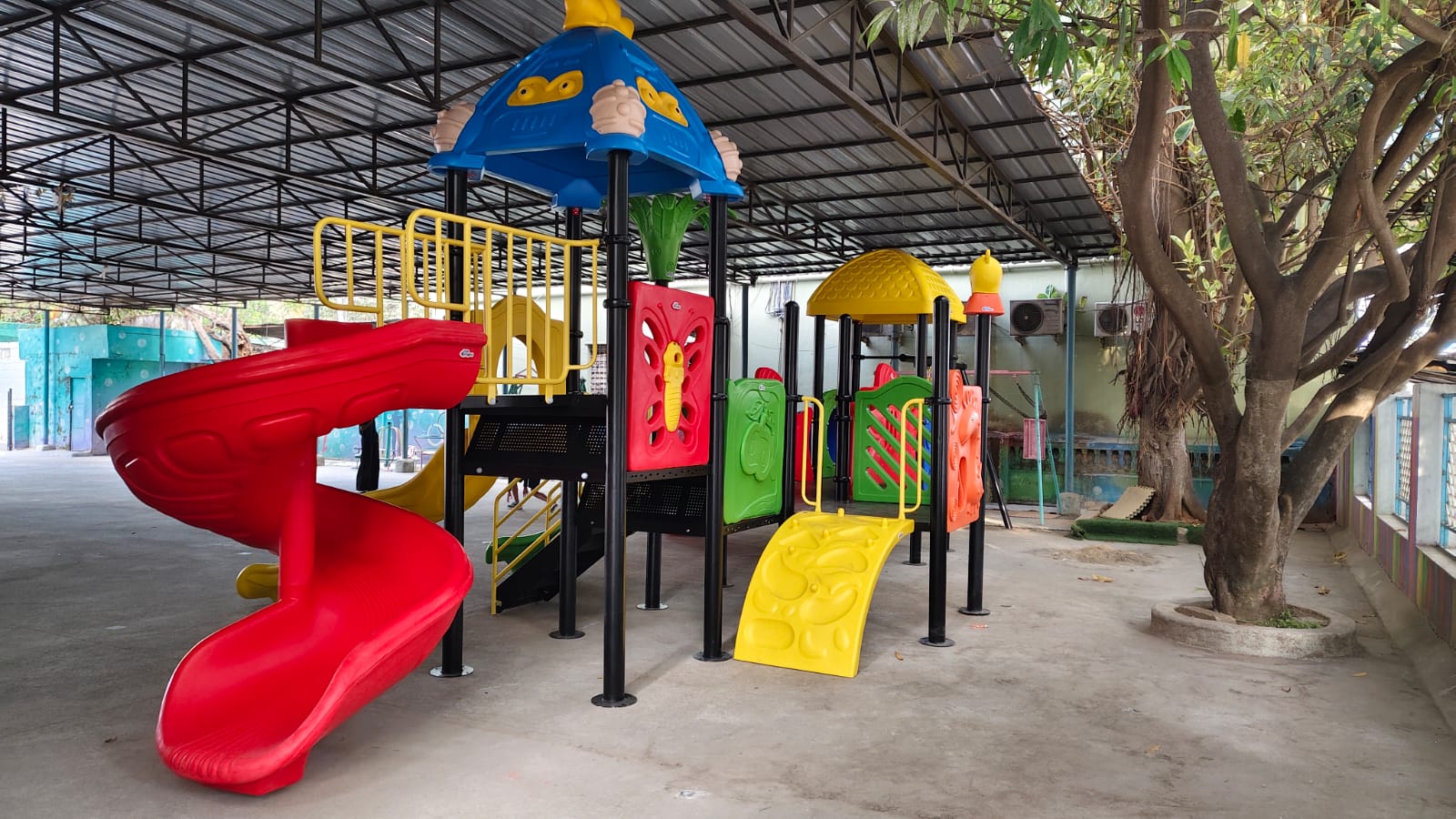 | OUTDOOR MULTIPLAY EQUIPMENT MANUFACTURER Combination of spiral slide, double slide,climbing ladders with double entery gate, canapy & cross railing and more. View product → |
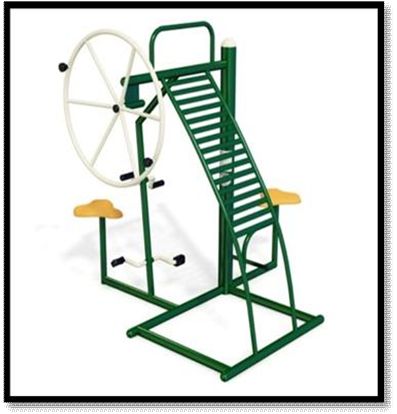 | OUTDOOR GYM MANUFACTURER 4 IN 1 COMBO ₹21500 Specification Main structure- Pipe- structure made of MS Pipe are 60od, 42 od and 32 od pipe OF 3 to 4 mm thickness Arm – structure made of MS pipe... |